Virtual Commissioning
Reducing project time and cost through early testing and validation of the automation design in a simulated environment.
Why Virtual Commissioning Matters
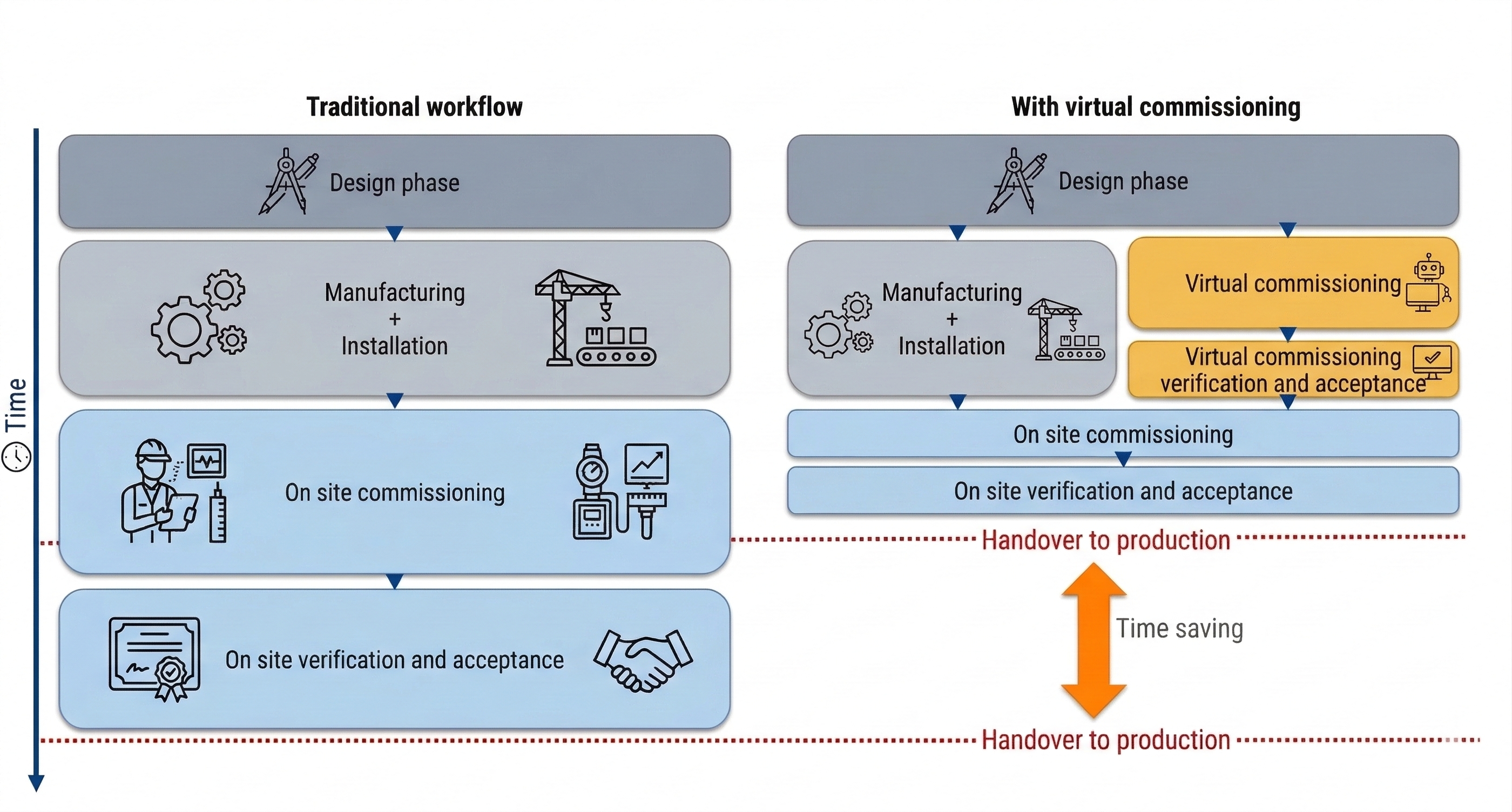
Virtual commissioning is the practice of testing and validating automation systems in a simulated environment before the real equipment is available on site, shifting much of the debugging work from the plant floor to the engineering phase of the project. In this environment, PLC logic, robot programs, station behaviour and interfaces between equipment can be verified using realistic process models and visualization.
By moving testing earlier in the project lifecycle, many issues that would normally appear during on-site commissioning are detected before installation. Problems related to layout, sequencing, interfaces, collisions, safety behaviour, recovery behaviour or cycletime can be identified and corrected long before the first equipment arrives on site.
During the design phase, virtual commissioning allows automation concepts and software behaviour to be validated while the mechanical design is still being finalized. Design issues discovered at this stage can be corrected with minimal impact, when changes are still relatively inexpensive to implement.
As the project progresses, the simulated environment enables extensive testing of control logic, robot programs and station behaviour without requiring large on-site teams or physical equipment. This allows engineering teams to iterate faster and eliminates the risk of damaging equipment during testing. By resolving many issues before installation, the amount of debugging required during on-site commissioning is significantly reduced, leading to lower commissioning effort and cost.
Finally, when the real line is installed, much of the testing and validation has already been completed. Commissioning teams can focus on integration and fine-tuning rather than fundamental problem solving, leading to much shorter start-up phases, lower cost and a higher technical availability at start of production.
How Virtual Commissioning Changes the Project
What Gets Validated
- PLC sequences, interlocks and safety-related logic
- Handshakes and interfaces between stations, robots and material handling
- Diagnostics, alarms and recovery behaviour
- Test scenarios that mirror real production conditions
Benefits for Production Projects
Significant project cost reduction
Smaller teams, no travel, no equipment damage risk. Simulation-based testing is fundamentally cheaper than on-site debugging
Early detection of design issues
Problems found in simulation can be resolved before equipment is manufactured and installed, when changes cost a fraction of what they cost on site
Reduced risk of project delay
Late-stage surprises are the most expensive kind. Virtual commissioning front-loads risk discovery, protecting the project schedule and budget
Reduced on-site commissioning time
More issues resolved before power-on means shorter, more focused on-site phases
Improved start-up stability
Fewer critical issues during ramp-up, leading to faster time-to-production and higher final technical availability
Enables short lead-time projects
When project timelines are compressed, virtual commissioning makes it possible to deliver what would otherwise not fit the schedule
Example Project
Greenfield automotive production line (2024–2025)
Virtual commissioning project coordinated by Loones Automation
In one large-scale automotive programme (2024–2025), virtual commissioning enabled a substantial part of buy-off testing to be completed before on-site start-up. This shifted critical debugging work earlier in the project and reduced late-stage schedule risk.
Scope: greenfield underbody line
- Greenfield underbody production line
- 50+ automated tooling stations and ~200 robots
- Multiple interfaces across stations, robots and material handling
Setup: software in the loop (SIL)
Full SIL setup with no physical hardware involved. All testing ran on virtual controllers and simulation models.
Siemens TIA Portal + PLCSim Advanced
The real PLC software runs in a virtual controller, behaving exactly as it would on the physical hardware.
WinMOD
Real-time simulation of field-level I/O, sensors, actuators and station behaviour. Provides the virtual plant model that the PLC controls.
ABB RobotStudio
Offline programming and simulation of ABB robot programs including path planning, reachability and cycle time validation.
Siemens Process Simulate
3D visualization and validation of the complete cell or line, including robot motions, material flow and equipment interactions.
Process Simulate visualization of a virtual station during testing
Results
- 80% of buy-off tests completed virtually
- From installation power-on to first complete automatic build (start of TT phase) in ~7 weeks
- From start of TT phase to SOP (start of production) in ~8 weeks
80%
of buy-off tests completed virtually
50+
automated tooling stations
~200
robots